The Proffessional Development Activity
General Information
Issues and Need of the PDA Activity

According to the World Health Organisation (WHO), sexuality education is based on learning about the 5 aspects of sexuality: cognitive, interactive, emotional, physical and social aspects of sexuality. (Source: WHO Regional Office for Europe and BZgA (2010). 'Standards for Sexuality Education in Europe: A framework for policy makers, educational and health authorities and specialists'.
This kind of education combines a wide variety of topics, including sexual and reproductive health, communication and relationships, sexual orientation and gender roles.Recent studies show that sexuality education positively impact young people's health: the increase in use of contraception and condoms, the reduce of risk of sexual abuse, the increase of self-efficacy and confidence. (Source: file: http///C:/Users/vikat/Downloads/KE-03-20-671-EN-N.pdf) In addition, sexuality education also contributes to reducing inequalities, quality education, gender equality, good health and wellbeing, which are European Commission's Sustainable Development Goals (SDGs).
1. We want at first, to help the participants to enrich their knowledge about methodology for sexual and reproductive education. During the training course there will be used a wide variety of non-formal education methods including forum theater, kinesthetic learning methodology, and others. This is an opportunity to share and gain new knowledge for future projects in the youth work field. In addition, participants will develop knowledge and understanding about consent and communication, safe space, identity, as well as specific terminology around these topics.
2.The project will be focused on developing tools that help to create a safe space and an inclusive environment, which is essential for sexual education. We will dedicate sessions on discussing what a safe space is, as well as learn about identity, gender and sexuality, and the mutual connection between feeling safe and speaking up.
3.The training course will help participants to develop practical skills for their youth work, such as planning and developing agenda for educational events, developing a digital booklet with methodology for youth workers, and building an educational campaign on sexuality education on social media, to reach the younger audience.
4. We are eager to enrich also the social competences and soft skills of the participants, such as raising empathy skills with youngsters of different social groups, gender identities and sexualities, raising emotional awareness, enhance cooperation, developing skills to think creatively, developing values of tolerance and responsibility, as well as reinforcing confidence and psychological resilience among educators in preventing and handling any kind of violence.
5. Thanks to project's sessions we want to inspire young people and youth workers to be more involved in activism, defending human rights, working in the field of feminism, helping the victims of any kind of violence, LGBTQ+ rights.
6. We are eager to work with interpersonal communication and improve communication skills through international cooperation and feedback techniques, as well as debriefing. We will develop such competences as active listening and working in pairs and teams, being aware of one's body, emotions, mental and physical state.
All the above are issues and needs that are coming to an agreement with the needs of all organizations (applicant and partners) and we are going to achieve all the above-mentioned goals and to develop new skills, exchange the experiences and create new materials and connections.
Timetable of the whole project

An Approximate timetable program with all actions that will be done in the training before and after the training.
February 2023:
- Starting of the program - first communication with the partners
- Initial online meeting for the aims and the whole procedure for partners organisations
- Selection of the participants. Signing contracts with the participants and the organisations
March 2023
- Create a group in Facebook with all the representatives of the participating organizations in the project for an easier exchange of ideas or questions about the program and for better communication, through sharing thoughts and actions.
- 2nd Online Meeting with all the participants for their preparation activities and info pack of our PDA. Setting the rules
May - June
2023
- The participants must do a research about the statistics & data on sexual education in their country, cases of abortions, gender based violence and create a mindmap that depicts this data.
May 2023
- Create a Web Page based on the project. The page will be created by the group from Cyprus and there all the information and material developed through the project will be published.
June 2023
- Publish to the Webpage of the project all the information and material developed through the project.
- Training Course from 19 to 26 of June
- Final online meeting with all participants and organisation so to be able to arrange any problems in follow up and dissemination activities
July -
September 2023
- Dissemination of results. All organisations will need to come in contact with their local area so all results of our project to be published and disseminated to a lot of people.
August 2023
- Evaluation of the program from organisations.
- Article preparation from groups by each country, writing about their work and what they have done during the whole program.
September
2023
- A booklet with educational tools for youth workers that will be formed during the training, is going to be published in our webpage. All organisations will send their final reports so all to be ready for our final electronic book of the results and the activities.
- Create videos about the whole project. One video will be prepared from each organisation.
- Final modification of our web page.
- End of the project
Program of the PDA
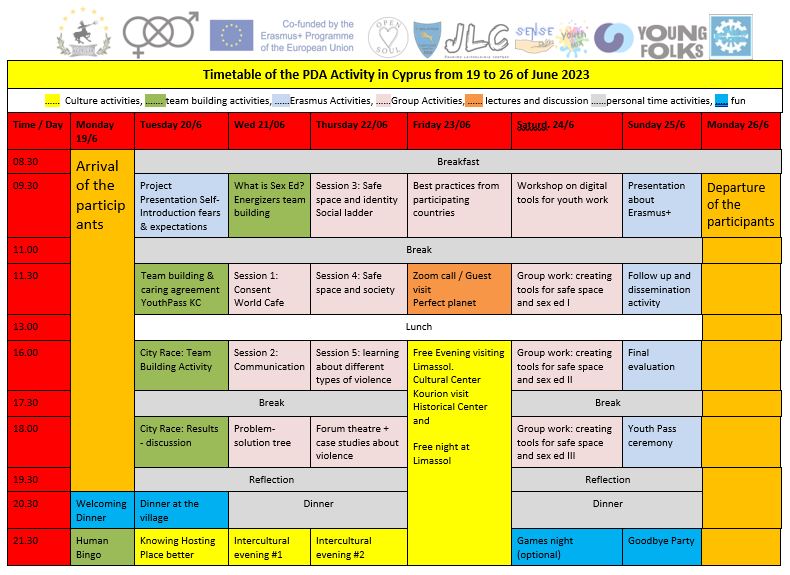
In the following table you can see the whole program of the activity from 19 to 26 of June 2023